
The Lily's Revenge
5 HOUR Epic Extravaganza with songs, film, puppets, and people
Don’t be afraid! If you can produce a production of Sweet Charity you can easily do The Lily’s Revenge.
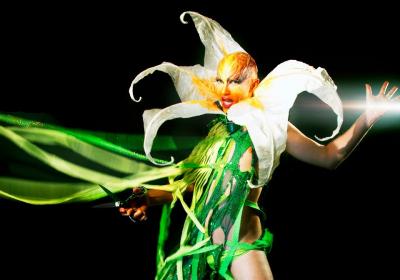
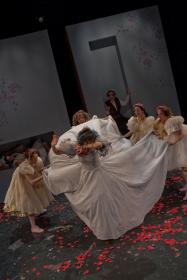
THE PLOT: The Great Longing Deity, a malicious Stage Curtain, has created a plague of nostalgia across the land. It is up to a five-petaled Lily to defeat the Curtain, bring an end to oppressive narratives, and wed the bride.
THE INSPIRATION: Lily was inspired by anti-gay marriage agendas, which use tradition and nostalgia as an argument for discrimination (“marriage has always been between a man and a woman”). It was also inspired by the ever-growing homogenization of our cities (“things aren’t the way they used to be”) and, perhaps most of all, the millions of flowers, suffocated in plastic, and thrown on the White House lawn, Buckingham Palace, and The Vatican in honor of Ronald Reagan, Pope John Paul II, and Princess Diana’s funerals.
THE COLLABORATORS: I believe theater is community action and as a playwright I am a community organizer. Lily continues this approach to making theater. It is a Five Act, Five Hour play with a cast of 40. The first four acts have roughly ten performers each, the final act has all forty. Each act is directed by a different director. A sixth director creates the intermission performances (what I loosely refer to as kyogens), which also utilize the entire ensemble.
SQUISHING GENRES: Lily is part Noh play (composed of five acts based on the Noh themes of Deity, Ghost-Warrior, Love, Living-Person, and Demon, for each act), part musical (Act I), part verse play (Act II), part instillation (Intermission Performances), part dance (Act III), part film (Act IV), and all of those things squished together (Act V). It lives in the theater and becomes a site-specific extravaganza. It is a multidisciplinary pastiche where a community of artists is brought together to enable community building of a scale rarely seen in the theater. It gives proof to the various communities (the audience and artists) of an active and present kinship: people capable of dispatching their compartmentalized norms.
THE GIST: Lily dismantles the established societal rules, traditions, myths, and tropes, which are used to keep us docile and imprisoned in the past. Then, while celebrating the pulled apart pieces, rearranges and glues them into the foundation of a new myth whose purpose is to inspire humanity in the here and now.


Cast Requirements
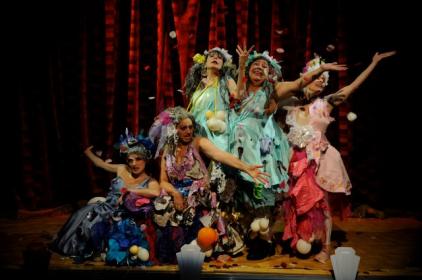
30 - 40 cast members of any age, gender or ethnicity.
Set Description
The Deity (Act I): a Princess Musical
In the proscenium. A stage on a stage. A play within a play.
The home of the Bride. An eclectic mish-mash of nostalgia. A
1950's Home and Garden photo display. A vaudevillian
theatrical. A Victorian picturebook. A movable window. A
brief moment where the Bride goes into the garden. Most
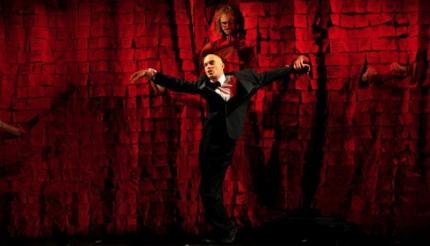
important an ominous red stage curtain that comes to life and
speaks.
The Ghost Warrior (Act II): An Act in Iambic, Song, and
Haiku. In the round. The Garden that is really a revolutionary
meeting place.
The Love Act (Act III): A Dream Ballet
A bare church/slash apartment. An aisle. The audience sits in
two distinct sections: The Bride's side and The Groom's side.
Taped outlines suggest furniture.
The Living Person (Act IV): A Silent Film
Screens surround all four sides of the audience. A cave of
technology. Audience members watch the act with their backs
to each other.
The Mad Demon (Act V): A Pastiche
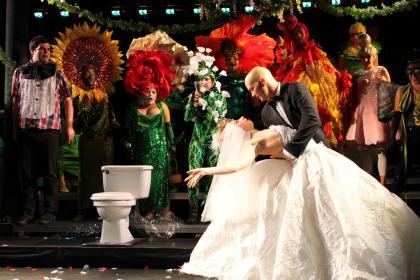
Back in the proscenium only much larger. Now there is no
longer a stage on a stage. The audience sits where the
performance was in the first act and the players primarily play
where the audience initially sat in the first act. Essentially
everything has been flipped. Action can happen in the audience
or on the stage. Most important. A larger and more ominous
red stage curtain made entirely out of red cocktail napkins has
replaced the stage curtain from The Deity (Act I) and also
comes to life, speaks, and needs to come crashing to the ground
in an instant.
Honors
2010 Obie Award.
Named Best Theatre of 2009 by The New Yorker, Time Out NY, The New York Post, Paper Magazine, Theatermania.com, Nytheatre.com, OnOffBroadway.com, NYMetroMix.com.
Press
“In its bravery, scope, creativity, extremity and sheer generosity of spirit, The Lily’s Revenge, to my mind, surpasses any American theater in New York this year. (Taylor Mac) is one of the most exciting theater artists of our time.”
—Adam Feldman, Time Out NY
Production and Development History
Premiere: HERE Arts Center in New York (2009), The Magic Theater (San Francisco, 2011), Southern Repertory (New Orleans, 2012), American Repetory Theater (2012)
Developed: HERE Arts Center’s HARP program with additional support from The Sundance Theatre Retreat, Abrons Arts Center, Ars Nova, New Dramatists, NYSCA, Creative Capital, The Map Fund, and Franklin Furnace.